
The Most Popular Rolex Models Since 2000: Prices Then and Now
Rolex prices have moved in ways few other consumer goods can match. A steel sports watch bought at retail two decades ago can now sell for two, three, even five times its original price. A handful of references drive that story, and the reasons behind their runs are worth understanding before you buy, sell, or just wonder what that watch sitting in your drawer is actually worth.
At Americash Jewelry & Coin Buyers, we look at these questions from a practical angle: we evaluate real watches every week and see firsthand how condition, references, and market demand shape resale value. If you’re curious what your own piece might be worth, browse our watches to get a feel for current pricing, or read on for a breakdown of the models that matter most.
Why Rolex Models From 2000 Onward Hold Their Value
The stainless steel professional models, particularly the Daytona, Submariner, and GMT-Master II, have historically held value better than most consumer goods. These references sit at the center of most Rolex demand because Rolex controls production tightly while global demand keeps climbing. That said, values move in both directions, and the correction that followed the 2021 to 2022 speculative peak is a useful reminder that past performance doesn’t guarantee future results.
Discontinued models tend to see the sharpest appreciation. Once Rolex retires a reference or switches to a new bezel material, remaining supply becomes fixed while demand keeps growing. That’s why certain older references now sell for multiples of their original MSRP, a pattern we’ll walk through model by model. Bob’s Watches sales data shows the average resale price across its listings climbed from $2,050 in 2010 to $13,426 in 2025.
Rolex Submariner: The Dive Watch That Started It All
The Submariner debuted in 1953, but the modern chapter starts with reference 16610, produced through 2010, followed by 116610LN from 2010 to 2020, and the current 126610LN. The Submariner remains the clearest example of steady, dependable appreciation rather than speculative spikes.
Original Retail Price vs. Today’s Resale Value
The 16610 retailed for around $6,000 in 2008. Today, pre-owned examples trade between $8,000 and over $12,000 depending on condition. The 116610LN, introduced with a Cerachrom ceramic bezel, now commands $11,000 to $14,000 or more. The current no-date reference 124060 retails at $10,050, with secondary market pricing running $11,000 to $13,500. The green-bezel “Kermit,” reference 16610LV produced from 2003 to 2010, originally retailed near $6,000 and now often sells in the $16,000 to $19,000 range, one of the most collectible references from that era.
Standout Features and Design Details
The 16610 paired a black aluminum bezel insert with the automatic Caliber 3135 and roughly 48 hours of power reserve inside a 40mm case, with Rolex switching to 904L steel partway through its run. The 116610LN upgraded to a Maxi case, a scratch-resistant Cerachrom bezel, and the Glidelock extension clasp, while keeping the Submariner’s long-standing 300 meters of water resistance.
The current 126610 grew to a 41mm case, adopted Caliber 3235, and extended power reserve to 70 hours. These incremental upgrades explain why the Submariner remains one of the most popular Rolex sport watches for collectors who want both history and daily wearability.
Rolex Daytona: A Slow Starter That Became the Market Leader
For decades, the Daytona was a slow seller. Today it’s arguably the most desirable Rolex chronograph on the market, and much of that shift traces back to actor Paul Newman, whose association with vintage Daytona models turned a once-overlooked reference into one of the most sought-after watches in the world.
Original Retail Price vs. Today’s Resale Value
Reference 116520, built around the in-house Caliber 4130 and produced from 2000 to 2016, launched at roughly $6,000. By the time Rolex discontinued it in 2016, retail had climbed to $12,200, more than doubling across its production run. Today, black-dial 116520 examples trade from the low to high $20,000s unworn, while early dial variants push into the low $30,000s.
Related references tell a similar story: the two-tone 116503 trades around $26,500, the yellow-gold 116518LN above $50,000, and the platinum 116506 near $145,000. The discontinued 116500LN, which replaced the 116520 in 2016, now runs from roughly $25,000 for a black dial in good condition to the high $30,000s for an unworn white Panda with full set. Current steel Daytonas retail at approximately $16,900, while the 126500LN trades between $30,000 and $35,000 on the secondary market, a premium of roughly double retail.
Standout Features and Design Details
The Daytona’s 40mm 904L Oystersteel case measures about 47mm lug-to-lug and roughly 12mm thick, with screw-down pushers, a tachymeter bezel, and a sapphire crystal rated to 100 meters. Later references introduced Cerachrom ceramic bezels starting in 2011 for precious-metal Daytonas and 2016 for the steel Daytona (ref. 116500LN), adding durability and a cleaner finish that collectors now specifically look for.
Rolex GMT-Master II: Built for Travelers
The GMT-Master II holds a unique place among Rolex’s professional lineup: it was the first Rolex to debut the Cerachrom ceramic bezel, a feature that quickly spread across the rest of the GMT family and helped make this the go-to reference for travelers and collectors alike.
Original Retail Price vs. Today’s Resale Value
Reference 16710 closed out an 18-year production run in the 2000s. It traded for just $4,500 to $5,500 in the early 2010s but now sells for $10,000 to $14,000, with the “Coke” bezel variant reaching $13,000 to $16,000, and boxed, unpolished examples exceeding $17,000. The ceramic-bezel 116710LN, produced from 2007 to 2018, traded in the $6,000 to $8,000 range for much of its production run and has generally sold in the $8,000 to $11,000 range since being discontinued.
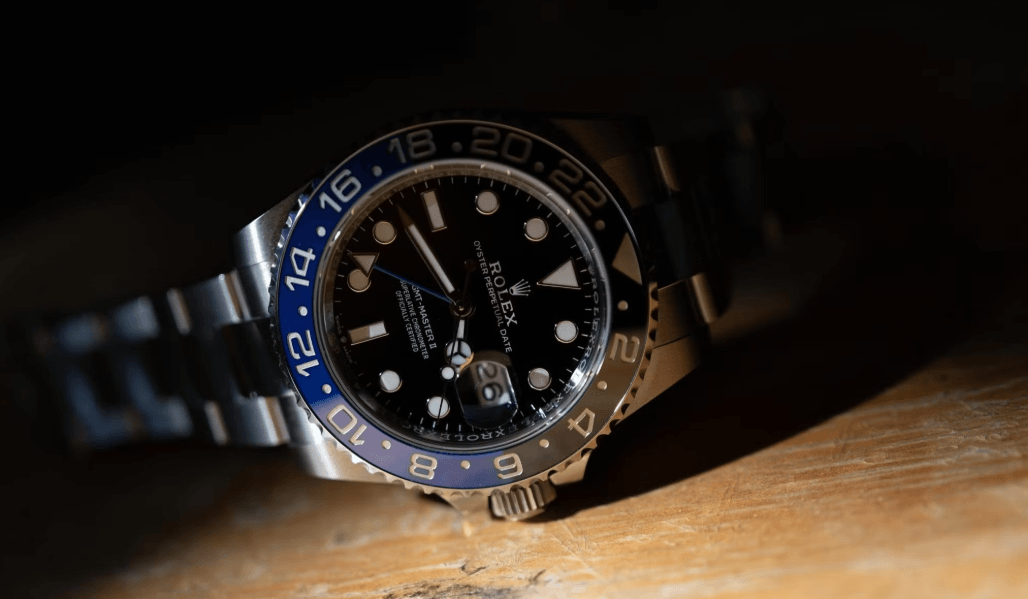
The “Batman” reference 116710BLNR retailed just under $9,000 in 2013 and now trades between $15,000 and $18,000. One 2013 example reportedly sold in 2025 for $17,500, a gain equal to roughly a 5.8% compound annual growth rate.
That figure may prove conservative: Rolex discontinued the “Pepsi” GMT in April 2026 with no direct replacement, and with no “Coke” in the catalog to absorb displaced demand, the Batman, Batgirl, and Sprite variants are the natural beneficiaries. Within the GMT-Master II family, reference 116710 topped 2025 sales volume, followed by 16710 and 126710.
Standout Features and Design Details
The 16710 offered user-swappable bezel inserts in Pepsi, Coke, and black colorways on a 40mm 904L steel case with a sapphire crystal and 100 meters of water resistance. The 116710LN moved to a full ceramic bezel, added maxi markers and a green GMT hand, and dropped the Jubilee option in favor of the Oyster bracelet exclusively. Collectors still argue over whether that was the right call.
Rolex Datejust: The Everyday Classic
If the sport models represent adventure, the Datejust represents Rolex’s classic side: a dependable, versatile dress watch and the brand’s best-selling collection since its 1945 debut.
Original Retail Price vs. Today’s Resale Value
Datejust resale values have climbed more than 320% over 15 years, moving from around $2,000 to $8,500, according to Bob’s Watches transaction data. Reference 16233, a 36mm two-tone Rolesor model combining steel and 18k yellow gold with a fluted bezel, remains the most popular Datejust and now sells for $5,500 to $8,500 or more depending on condition.
Two-tone 1990s examples with original box and papers currently trade for $7,000 to $9,500, up from roughly $4,500 just five years ago. Bob’s Watches data shows the Datejust collection remains the most heavily traded Rolex line overall, even though average prices have pulled back about 14% from their March 2022 peak of $9,926 to roughly $8,500 in 2025. The green “Wimbledon” dial variant now trades above retail.
Standout Features and Design Details
The 16233 paired Caliber 3135 with a sapphire crystal and Rolesor construction, giving it a dressier profile than the sport references. Current models like the 126200, 126234, and 126334 run Caliber 3235 with 70 hours of power reserve.
Unlike the explosive gains seen in steel sports models, the Datejust appreciates steadily, retaining 70% to 90% of its retail value over time, which makes it a reliable entry point for anyone building a first Rolex collection.
What Drives Rolex Price Appreciation Over Time
Across every model we’ve covered, a few forces repeat themselves. Scarcity created by discontinuation tends to drive appreciation, as seen with the “Hulk” Submariner after Rolex pulled it from production. Steel sports models consistently outperform precious-metal versions because broader demand exists for them.
Originality matters just as much as rarity. Box, papers, and warranty documentation can add 10% to 20% to resale value, while non-original parts can reduce value by up to 40%. Mint condition pieces typically command 15% to 30% more than worn examples. When we assess authenticity, we look at Swiss watch certification standards and Rolex’s own documentation practices, since these remain the industry’s reference points for verifying originality.
It’s worth noting that watch values fluctuate with broader market conditions, and Americash Jewelry & Coin Buyers is not a financial advisor. Anyone considering a Rolex purchase as an investment should consult a qualified financial professional rather than relying solely on historical pricing trends.
Getting the Most Value When You Sell Your Rolex
Selling a Rolex for the most value comes down to documentation, condition, and choosing the right buyer. Keep original boxes, papers, warranty cards, and even receipts if you have them. Avoid aftermarket parts or unauthorized repairs, since they can meaningfully lower resale value.
For Westmont-area collectors and clients we’ve worked with across the western Chicago suburbs, we recommend getting a professional appraisal before selling anywhere, simply to understand what your specific reference and condition are worth in today’s market. You can start that process anytime by requesting a free estimate from our team, and you can also browse our used watches for sale to see how comparable pieces are priced.
Sell Your Rolex to Americash Jewelry & Coin Buyers
Why Collectors Trust Us
In our 20+ years evaluating luxury watches at our Westmont, Illinois location, we’ve seen firsthand how much these Rolex models ranked among the most collectible pieces can appreciate when properly cared for. Our team, led by Brian “The Cashman” Hoogeveen and recognized on WGN 720, brings over 100 years of combined experience appraising gold, jewelry, coins, and watches.
Get Your Free, No-Pressure Appraisal
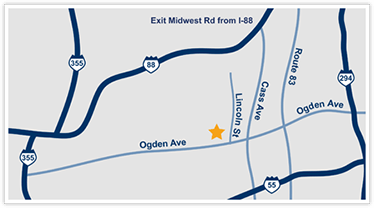
We offer a complimentary, no-pressure appraisal with no upfront fee, and we pay cash immediately based on fair market pricing tied to current evaluation standards, not guesswork. Located just 10 minutes from Hinsdale and 30 minutes from Chicago, we serve clients throughout western Chicago, Wisconsin, Iowa, Missouri, Kentucky, and Indiana.
If you’re ready to sell a Submariner, Daytona, GMT-Master II, or Datejust, or simply want to know what your watch is worth, browse our current Rolex watches for sale for context, then reach out to us online or call us directly at 630-969-9600.
Tags: Popular Rolex Watches, Rolex Datejust, Rolex Daytona, Rolex GMT-Master II, Rolex Models, Rolex Resale Value, Rolex Submariner, Sell Rolex